
About this edition
Illuminating possibilities.
AI is supposed to make work easier, but new data says otherwise. This week on the SMB Pulse, we dig into what that means for your team, alongside a federal funding announcement that Canadian employees shouldn’t miss.
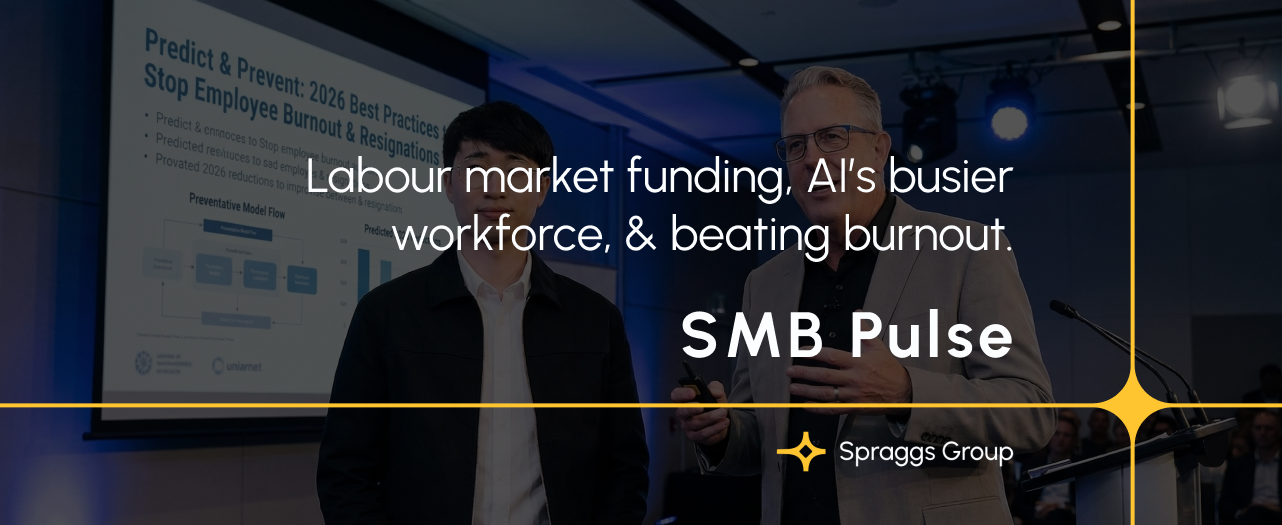
We're also hosting a free webinar on April 2nd with Employment Hero's Interim Regional CEO KJ Lee, and our own CSO, Dave Harrhy, built for anyone managing people in 2026 and wondering why retention keeps getting harder.
Ottawa invests in Labour Market Intelligence
$94.5M to close Canada’s growing skills shortage.
Finding skilled workers is one of the most consistent problems for Canadian SMBs, and it isn’t getting easier. The federal government’s Sectoral Workforce Solutions Program aims to address this national issue — it's investing $94.5 million over five years to support 14 industry organizations tasked with building real labour market intelligence for their sectors.
In practice, this means Canadian businesses will receive more employer-facing resources, including updated occupational standards, training curricula, HR tools, and 10-year forecasts of where workforce gaps are heading. The funding covers most of the industries where hiring pressure is most acute right now: Agriculture, construction, energy, forestry, mining, manufacturing, ICT, and more.
These sectors track closely with where the government has placed its economic priorities: housing construction, clean energy, domestic resource development, and digital infrastructure. If your business sits in any of these industries, there is now a federally funded organization whose job is to analyze workforce struggles so the government can build programs to help solve them.
Most of them already publish research, employer toolkits, and training resources at no cost. The new funding means those resources will be more current and tied to where the labour market is actually heading over the next decade, not where it was three years ago.
ActivTrak’s AI Adoption & Workforce study
Is AI really giving your team time back?
One of the most widely held assumptions about AI in the workplace is that it reduces workload. Employees use it to move faster, finish tasks sooner, and recover time for higher-value work. However, a large new study from the ActivTrak Productivity Lab challenges that directly, with data drawn from over 443 million hours of real workplace activity.
The 2026 State of the Workplace report analyzed more than 443 million hours of workplace activity across 1,111 organizations and 163,638 employees over three years — one of the largest behavioural datasets on this subject published to date. The finding that stands out: AI is accelerating workloads, not lightening them.
- 80% of employees now use AI tools at work, up from 53% two years ago
- Time spent in AI tools has increased eightfold since 2023
- After AI adoption, activity across every measured work category went up 27% to 346%
- Email volume increased 104%. Chat and messaging increased 145%
- Weekend work increased by more than 40%
- Average daily focus time for AI users declined by 23 minutes
- Focus efficiency fell to a three-year low, with average focus sessions of just 13 minutes
The picture that emerges is one of amplification, as AI is helping people do more, but the volume of work being created alongside it is also growing. The workday shrank slightly, but the density and pace of what happens inside it increased. Productive hours went up 5%, while collaboration surged 34% and multitasking rose 12%.
There is a narrow sweet spot worth noting: employees who spend 7 to 10% of their work hours in AI tools show the highest productivity rates of any group, though only 3% of AI users currently fall in that range. Most organizations have rolled out AI tools without building any structure around how they are used, or any way to measure whether the investment is actually working.
The practical takeaway for Canadian business owners is that adding AI tools to your team's workflow without thought to capacity and structure will likely increase output and workload simultaneously. Without visibility into how your team is actually spending their time, the efficiency gains are hard to capture, and the burnout risk grows quietly in the background.
What to do: Before adding another AI tool, audit how your team is using the ones already in place. Are they absorbing the right tasks? Is output going up while focus time is going down? The gains are proven, but they require some governance to land where you want them.
Stop burnout before it starts.
Live webinar with Employment Hero, April 2nd.
The data from this week's AI story points to something business owners across every industry are already feeling: the pace of work is increasing, and the people absorbing that pace are wearing down faster than most leaders notice. Some are left with less meaningful work than before, as few businesses have figured out what to do with the capacity that AI freed up.
On April 2nd, Spraggs Group's CSO Dave Harrhy and Employment Hero's Interim Regional CEO KJ Lee are hosting a complimentary, live one-hour webinar on exactly this. The session is built around getting ahead of the problem with real data and systems, not gut-feel management after the fact.
This session will cover:
- Why burnout is spreading faster than most leaders realize
- How to build a data-forward feedback culture that employees actually trust
- Proven retention mechanics across recognition, career development, and mental health
- What to do when your team is already struggling
- The compensation and benefits trends defining employee loyalty in 2026
The session runs on April 2nd, 3:00 to 4:00pm PT. If you miss it live, it will be available on demand afterward.

Are you a growing SMB?
Discover how Spraggs Group’s HR, financial, and legal consulting services can help your business succeed.