
About this edition
Illuminating possibilities.
Is your business in need of capital? This week, we take a look at funding opportunities for Canadian SMBs that are struggling from tariffs, expanding internationally, or those in agriculture. Plus, there’s a labour shortage in rural Canada, despite high unemployment. We dive into the numbers and the federal government’s response.
Anthrophic released a labour market impact report with cold, hard data about the state of AI and human work — with some shocking insights into AI’s reach and how it’s changing your team’s workload. Read on to learn more.
4 funding programs worth knowing about
There’s money on the table for Canadian SMBs.
The current trade environment is pushing Canadian businesses to look beyond the U.S. for customers, suppliers, and growth — a direct response to the increasing financial pressures from U.S. tariffs and market uncertainty. Thankfully, Ottawa is extending a helping hand to Canadian businesses through a new wave of programs designed to help SMBs overcome the current climate.
We’ve compiled a list of four funding programs worth looking at, before the windows close.
CanExport SMEs: This program covers up to 50% of eligible international business development costs, capping at $50,000 per project. Applications are open until May 29, 2026 on a rolling competitive basis — meaning funding is awarded as applications come in, not at a set deadline. If your business is looking to enter new international markets, this is one of the most accessible federal programs available.
BDC's Pivot to Grow Loan: Canadian business bearing the brunt of U.S. tariffs: you may be able to access up to $2 million in funding from BDC, including interest-only payments for up to 12 months and repayment over as long as 72 months. To qualify, businesses must be able to demonstrate direct or indirect negative material impact on their operations due to tariffs and a plan to adjust to the new trade environment.
EDC's Trade Expansion Lending Program (TELP): Need more working capital? TELP acts as a guarantee that helps you access more working capital from your financial institution. EDC shares the risk with your lender by guaranteeing part of your loan or line of credit, allowing them to offer the credit conditions you need to grow.
ArgiMarketing Program: For those in agriculture, agri-food, fish, or seafood, a new funding stream opened in February that's worth your attention. A total of $75 million will be invested over five years starting in 2026-27, and for the first time, the program includes funding specifically for small and medium-sized enterprises — a group that was previously excluded. Individual projects can receive up to $100,000 in non-repayable contributions.
Canada’s rural labour shortage
Rural businesses are bearing the brunt.
We’ve discussed previously on the SMB Pulse about the ongoing labour shortage, concluding that it may be more of a skilled talent shortage for growing firms. The recent February 2026 Labour Force Survey revealed that unemployment reached 6.7% — among the highest in the G20 — while participation rate fell to 64.9%. For skilled job seekers, the situation remains difficult; people aren’t finding the right roles for their skillsets.
But for local businesses, especially in rural Canada, the workers aren’t available where the jobs are. The Temporary Foreign Worker program was designed as a lifeline for these businesses, but the outlook is dim. More than 1.3 million work permits are set to expire in 2026, creating a real operational threat for many businesses.
The federal government has responded by raising the TFW cap from 10% to 15% next month for rural small businesses — a targeted measure that acknowledges where the shortage is most acute. Will this tweak in the cap change the tides for local businesses? We’ll have to wait and see.
Anthropic paper challenges displacement narrative
AI is making workers busier, not replacing them.
A new paper from Anthropic published earlier this month suggests the “AI is taking our jobs” narrative is far more complicated than the general consensus — and more relevant to how Canadian business owners think about hiring and workforce planning.
The research introduces a new measure called observed exposure, which combines theoretical AI capability with real-world usage data, weighting automated and work-related uses more heavily. The key finding: AI is far from reaching its theoretical capability, and actual coverage remains a fraction of what's feasible.
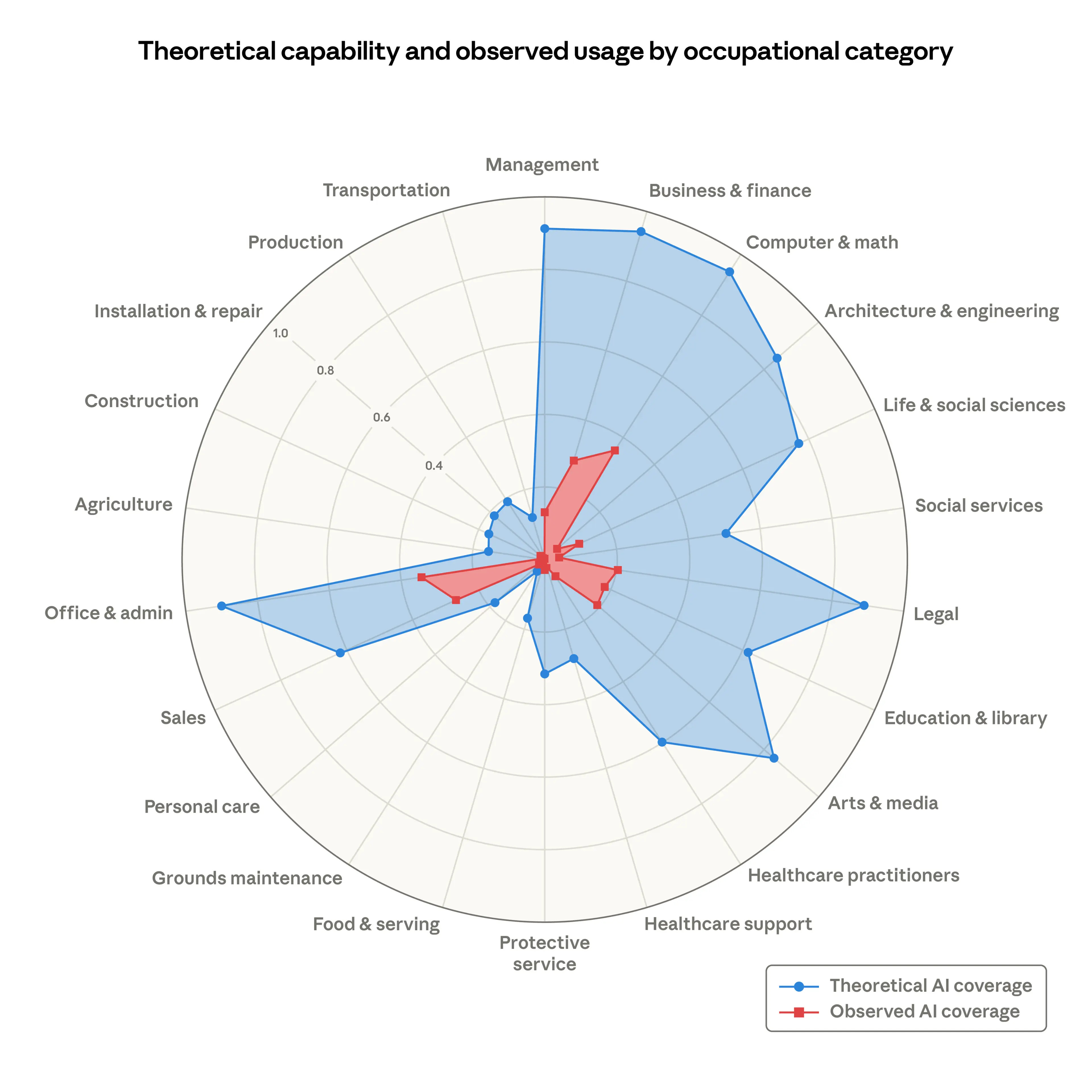
Occupations with higher observed exposure are projected by the Bureau of Labor Statistics to grow less through 2034, and workers in the most exposed professions are more likely to be older, female, more educated, and higher-paid. That’s a different profile than most displacement narratives assume.
The research finds no systematic increase in unemployment for highly exposed workers since late 2022, though there is suggestive evidence that hiring of younger workers has slowed in exposed occupations, Antrophic reports.
What this means for Canadian SMBs and the employed is that AI poses a risk to the workforce that is more gradual and occupation-specific than the headlines suggest. The more immediate concern, as last week's ActivTrak data showed, is AI increasing workloads rather than reducing them. Businesses that roll out AI tools without thinking about capacity and structure are likely to see output go up alongside burnout risk.
As a business leader, we urge you to ask yourself: do you have the HR foundation to protect your most expensive and invaluable asset — your people — when burnout becomes status quo and AI takes over low-value tasks?

Are you a growing SMB?
Discover how Spraggs Group’s HR, financial, and legal consulting services can help your business succeed.