
Future Proofing Your SMB: Navigating Strategy and Risk in the Age of AI

If you run a small or medium-sized business in Canada, you have probably already felt the pressure. Competitors are automating. Clients are asking whether your systems are up to date. And somewhere in the back of your mind, a quiet question keeps surfacing: are we falling behind?
The data suggests many Canadian SMBs are. According to the Business Development Bank of Canada, only 30% of Canadian SMEs used AI in 2025, yet those businesses were 24% more productive than those that did not. The gap is not closing. It is widening.
The opportunity is real. But so are the risks. AI adoption is introducing legal, operational, and governance challenges that many businesses are underestimating. Can employees safely use generative AI tools? What happens when confidential information is uploaded into an external platform? Are AI-generated contracts enforceable? These are active issues, not future ones. This article breaks down what to watch for and how to build a strategy that holds up over time.
Why AI Strategy Has Become an Executive Priority for Canadian SMBs
AI adoption in most organizations starts informally. An employee uses a public platform to summarize contracts. Another drafts HR documents with a generative tool. Marketing automates workflows without a compliance review. None of these decisions are dramatic on their own. Collectively, they can create data privacy exposure, intellectual property uncertainty, inconsistent documentation, and regulatory gaps.
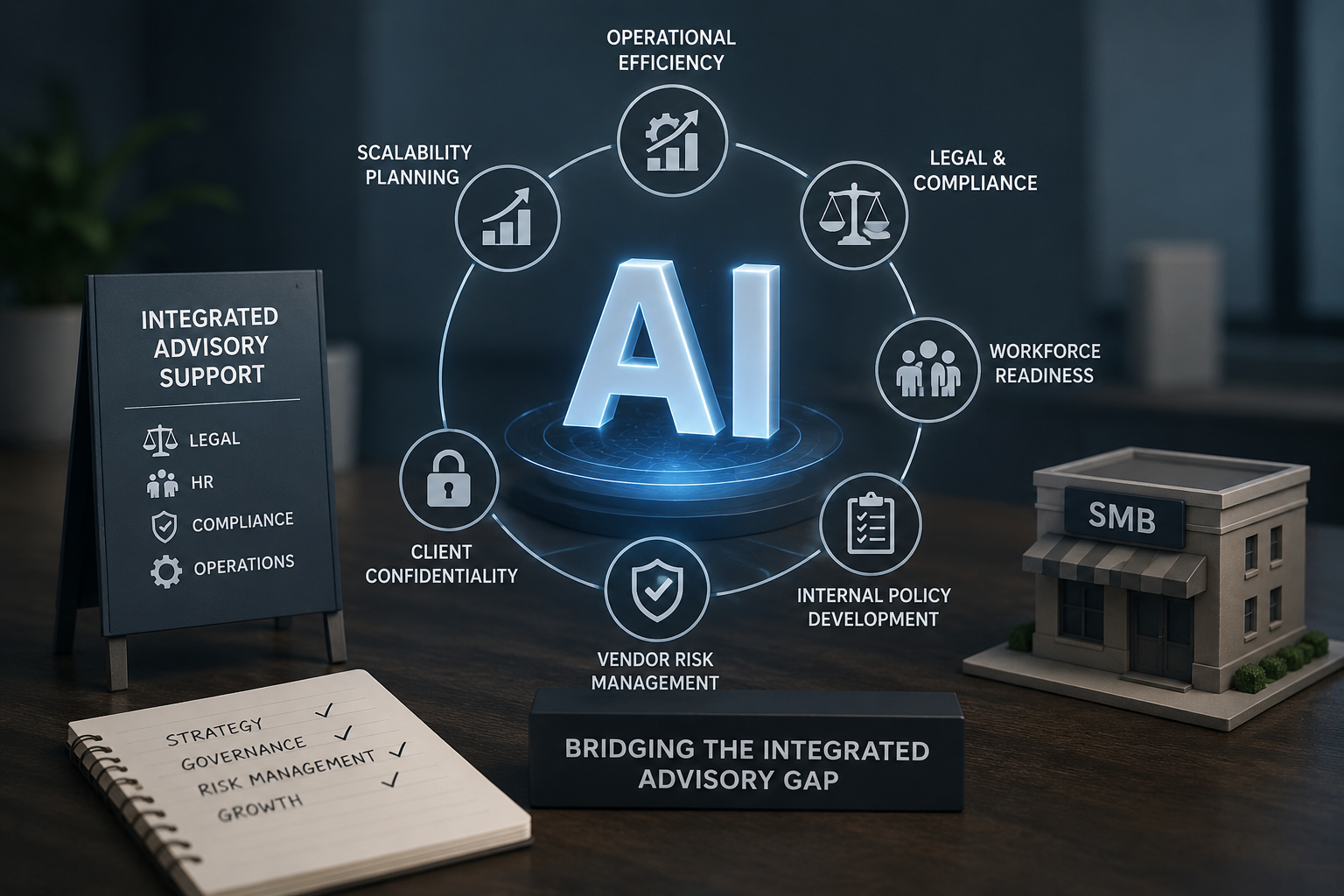
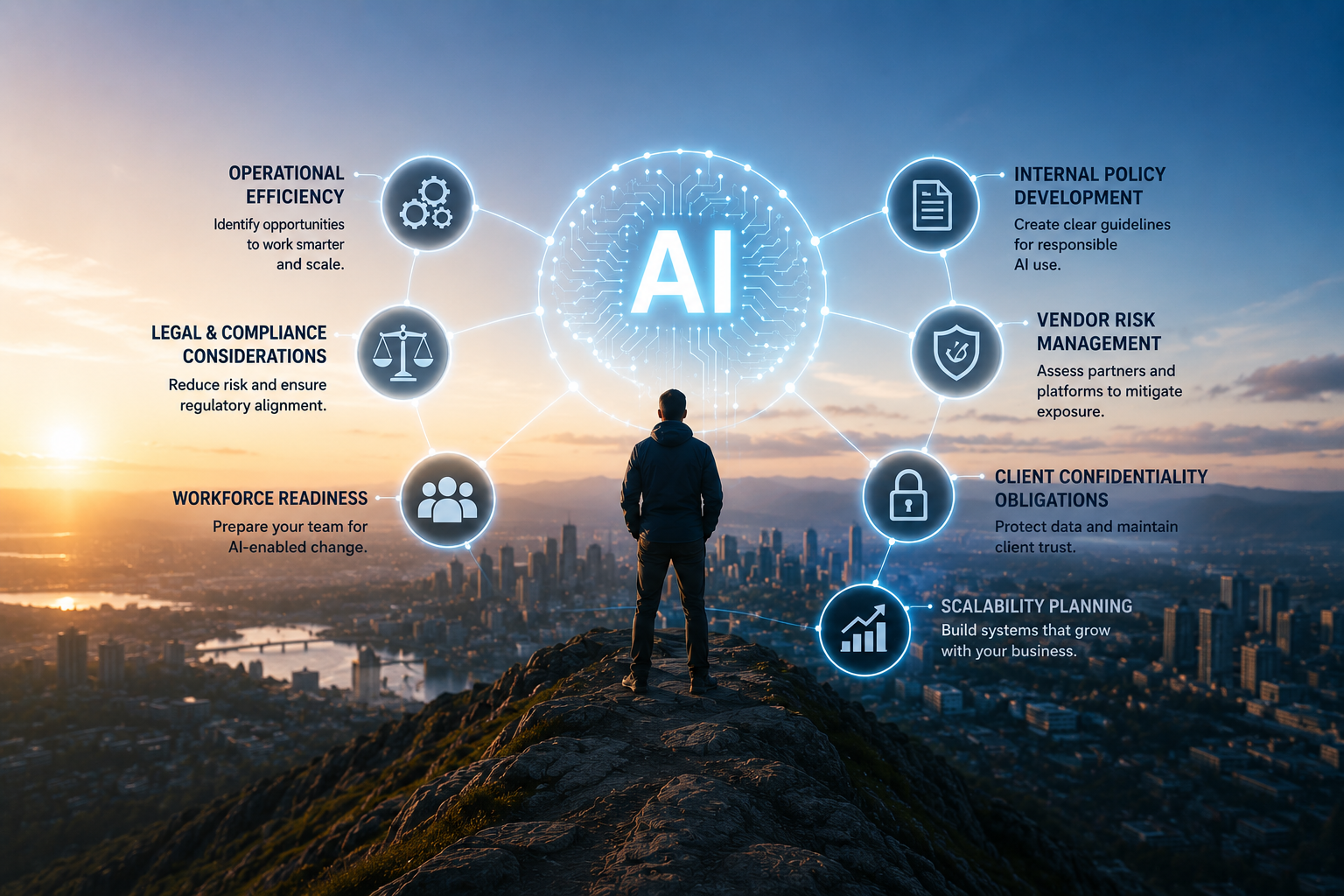
This is why AI business strategy in Canada is becoming an executive-level conversation rather than an IT initiative. A strong strategy needs to address operational efficiency, legal and compliance considerations, internal policy development, vendor risk, and workforce readiness. For most SMBs, that kind of integrated thinking requires outside guidance, because few organizations have legal, HR, and operational strategy working together in-house.
The Real Upside of AI Powered Business Tools
Before addressing risk, the upside deserves equal attention. AI powered business tools favour agile SMBs in ways that were not possible even a few years ago.
- Operational efficiency. Automating document drafting, scheduling, reporting, and communication workflows frees up significant staff time in lean organizations.
- Workforce leverage. BDC research found that 22% of businesses using AI reported a reduced need to hire additional staff for the same workload. In a tight labour market, that matters.
- Better decisions. AI analytics give SMB owners access to forecasting and customer insight that was previously out of reach for smaller organizations.
- Competitive positioning. Operational sophistication is increasingly a factor in how clients, partners, and investors evaluate businesses. AI adoption is becoming a signal of organizational maturity.
The question is not whether to engage with AI. It is how to do so in a way that creates durable value without introducing risk you cannot manage.
The Legal Risks of AI for SMBs Are Hiding in Everyday Operations
Most legal exposure does not come from sophisticated AI systems. It comes from ordinary employees using publicly available tools without governance in place.
Data Privacy and PIPEDA Compliance
Cloud-based AI tools require access to data to function. When employees upload customer records, contracts, or financial information into external platforms, that data may be retained or processed in ways the organization never anticipated. In Canada, this creates obligations under PIPEDA and, in Quebec, under Law 25. If your AI vendor is transmitting client data outside of Canada, you may already have a compliance gap. Vendor agreements need to be reviewed before adoption, not after.
Contract Enforceability and IP Ownership
AI-generated legal language can appear polished while containing unenforceable clauses, outdated terms, or language that is inconsistent with Canadian law. A flawed contract is often invisible until a dispute surfaces. Similarly, ownership of AI-generated work products, whether marketing content, code, or documentation, remains legally ambiguous under current Canadian IP frameworks. If your team is producing deliverables for clients or building proprietary systems using AI tools, your IP position needs a review.
HR and Employment Law Exposure
AI is increasingly used in hiring, performance evaluation, and workforce planning. Without updated policies, organizations can unintentionally introduce bias, privacy issues, or employment standards violations. Auditing your HR practices against current AI-driven workflows, before issues arise, is part of responsible AI governance.
How to Build a Future-Proof AI Strategy
A future-proof strategy is not a technology roadmap. It is a business operating framework that lets you adopt new tools, absorb disruption, and make clear decisions as conditions change. A few principles matter most.
Start with assessment, not tool selection. The most common mistake is leading with software. Sustainable adoption starts with clarity about where your highest-value activities are, where bottlenecks exist, and where your legal and financial risk lives. Spraggs Group’s Illuminate service (spraggsgroup.com/illuminate) is built for exactly this: an organizational assessment that integrates legal, HR, and financial perspectives before any tool decisions are made.
Build a usage policy early. Even a simple internal AI governance policy reduces risk significantly. It should clarify approved tools, prohibited uses, confidentiality expectations, review requirements for AI-generated outputs, and accountability structures.
Align your legal infrastructure. Scaling AI adoption without updated legal infrastructure amplifies whatever vulnerabilities already exist. Spraggs Group’s legal team, grounded in Spraggs Law’s decades of Canadian practice, helps businesses align vendor agreements, contracts, and HR policies with current law. See spraggsgroup.com/what-we-do
Build a model, not just a toolkit. There is a difference between using AI tools and building an AI-assisted operating model. Vistera (spraggsgroup.com/vistera), Spraggs Group’s SMB copilot, combines AI capabilities with ongoing legal, HR, and financial advisory support so your systems and strategy stay aligned as you grow.
Plan for regulatory evolution. Canada’s AI regulatory environment is still developing. The federal Artificial Intelligence and Data Act and Quebec’s existing enforcement framework signal where things are heading. Build in semi-annual reviews of your AI practices, vendor agreements, and internal policies as a standing governance discipline.
The Businesses That Get This Right Will Have a Real Advantage
BDC research projects that SME productivity could rise by up to 38% if Canadian businesses reached a high level of digital maturity. Most are nowhere near that yet. The businesses that close that gap will not necessarily be the fastest movers. They will be the most deliberate: governing effectively, aligning leadership around strategy, and building systems that absorb change rather than get disrupted by it.
That is not a goal reserved for enterprises with in-house legal teams and dedicated strategy functions. Any SMB that approaches AI with the same seriousness it brings to a major financial decision can get there. The edge for smaller businesses has always been agility. Pair that with strategic and legal discipline and you have something durable.
Take the Next Step With Spraggs Group
Spraggs Group brings together senior legal, HR, and financial expertise to help Canadian SMB owners adopt AI tools safely, align their contracts and policies with current law, and build strategies that hold up as conditions evolve. Whether you are just starting to assess your AI readiness or already deep in adoption and wondering what you may have missed, the right starting point is a clear view of where your business stands today.
Book a call at spraggsgroup.com/book-a-call, or explore what we do at spraggsgroup.com/what-we-do.