
Insights

If you run a small or medium-sized business in Canada, you have probably already felt the pressure. Competitors are automating. Clients are asking whether your systems are up to date. And somewhere in the back of your mind, a quiet question keeps surfacing: are we falling behind?
The data suggests many Canadian SMBs are. According to the Business Development Bank of Canada, only 30% of Canadian SMEs used AI in 2025, yet those businesses were 24% more productive than those that did not. The gap is not closing. It is widening.
The opportunity is real. But so are the risks. AI adoption is introducing legal, operational, and governance challenges that many businesses are underestimating. Can employees safely use generative AI tools? What happens when confidential information is uploaded into an external platform? Are AI-generated contracts enforceable? These are active issues, not future ones. This article breaks down what to watch for and how to build a strategy that holds up over time.
Why AI Strategy Has Become an Executive Priority for Canadian SMBs
AI adoption in most organizations starts informally. An employee uses a public platform to summarize contracts. Another drafts HR documents with a generative tool. Marketing automates workflows without a compliance review. None of these decisions are dramatic on their own. Collectively, they can create data privacy exposure, intellectual property uncertainty, inconsistent documentation, and regulatory gaps.
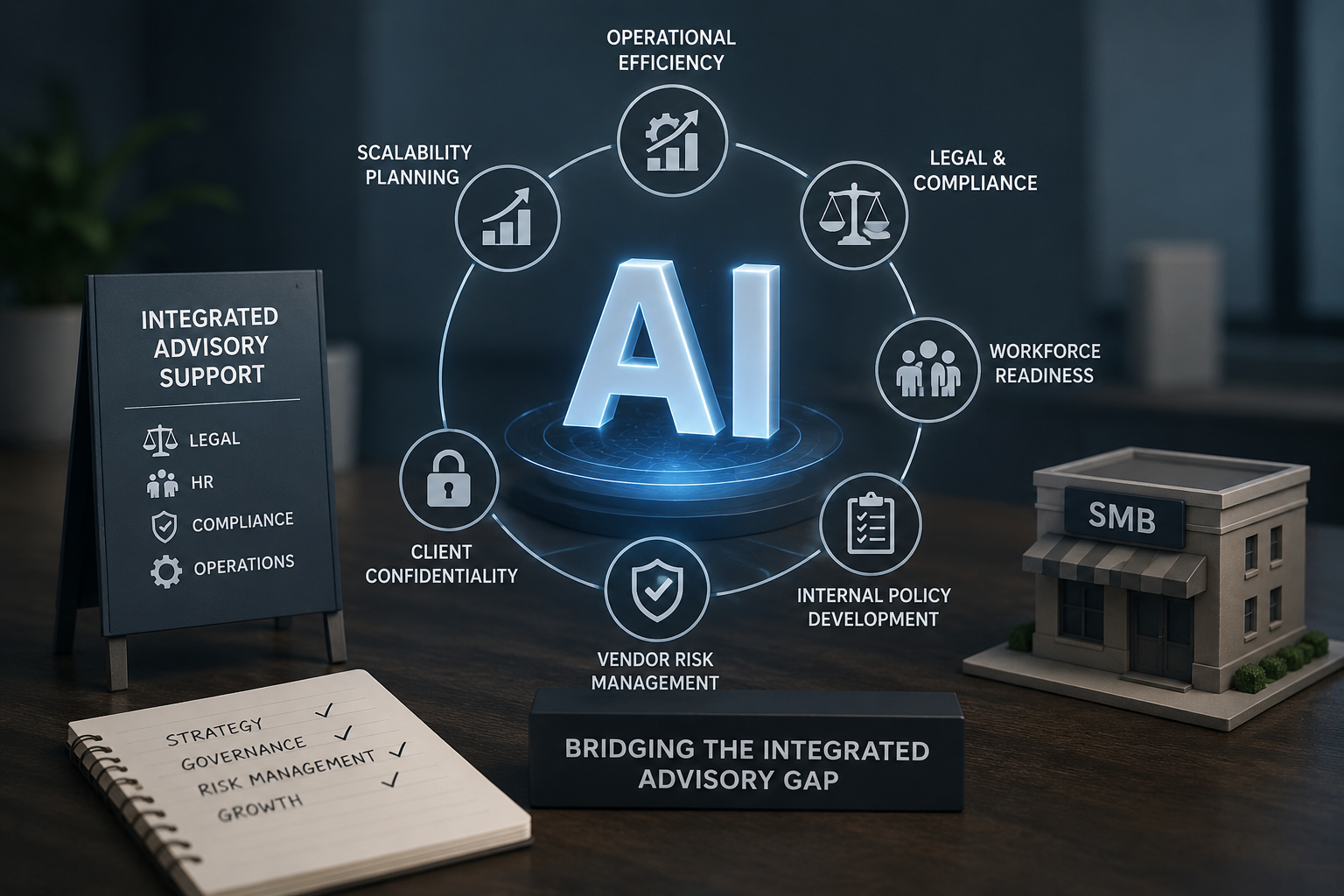
This is why AI business strategy in Canada is becoming an executive-level conversation rather than an IT initiative. A strong strategy needs to address operational efficiency, legal and compliance considerations, internal policy development, vendor risk, and workforce readiness. For most SMBs, that kind of integrated thinking requires outside guidance, because few organizations have legal, HR, and operational strategy working together in-house.
The Real Upside of AI Powered Business Tools
Before addressing risk, the upside deserves equal attention. AI powered business tools favour agile SMBs in ways that were not possible even a few years ago.
- Operational efficiency. Automating document drafting, scheduling, reporting, and communication workflows frees up significant staff time in lean organizations.
- Workforce leverage. BDC research found that 22% of businesses using AI reported a reduced need to hire additional staff for the same workload. In a tight labour market, that matters.
- Better decisions. AI analytics give SMB owners access to forecasting and customer insight that was previously out of reach for smaller organizations.
- Competitive positioning. Operational sophistication is increasingly a factor in how clients, partners, and investors evaluate businesses. AI adoption is becoming a signal of organizational maturity.
The question is not whether to engage with AI. It is how to do so in a way that creates durable value without introducing risk you cannot manage.
The Legal Risks of AI for SMBs Are Hiding in Everyday Operations
Most legal exposure does not come from sophisticated AI systems. It comes from ordinary employees using publicly available tools without governance in place.
Data Privacy and PIPEDA Compliance
Cloud-based AI tools require access to data to function. When employees upload customer records, contracts, or financial information into external platforms, that data may be retained or processed in ways the organization never anticipated. In Canada, this creates obligations under PIPEDA and, in Quebec, under Law 25. If your AI vendor is transmitting client data outside of Canada, you may already have a compliance gap. Vendor agreements need to be reviewed before adoption, not after.
Contract Enforceability and IP Ownership
AI-generated legal language can appear polished while containing unenforceable clauses, outdated terms, or language that is inconsistent with Canadian law. A flawed contract is often invisible until a dispute surfaces. Similarly, ownership of AI-generated work products, whether marketing content, code, or documentation, remains legally ambiguous under current Canadian IP frameworks. If your team is producing deliverables for clients or building proprietary systems using AI tools, your IP position needs a review.
HR and Employment Law Exposure
AI is increasingly used in hiring, performance evaluation, and workforce planning. Without updated policies, organizations can unintentionally introduce bias, privacy issues, or employment standards violations. Auditing your HR practices against current AI-driven workflows, before issues arise, is part of responsible AI governance.
How to Build a Future-Proof AI Strategy
A future-proof strategy is not a technology roadmap. It is a business operating framework that lets you adopt new tools, absorb disruption, and make clear decisions as conditions change. A few principles matter most.
Start with assessment, not tool selection. The most common mistake is leading with software. Sustainable adoption starts with clarity about where your highest-value activities are, where bottlenecks exist, and where your legal and financial risk lives. Spraggs Group’s Illuminate service (spraggsgroup.com/illuminate) is built for exactly this: an organizational assessment that integrates legal, HR, and financial perspectives before any tool decisions are made.
Build a usage policy early. Even a simple internal AI governance policy reduces risk significantly. It should clarify approved tools, prohibited uses, confidentiality expectations, review requirements for AI-generated outputs, and accountability structures.
Align your legal infrastructure. Scaling AI adoption without updated legal infrastructure amplifies whatever vulnerabilities already exist. Spraggs Group’s legal team, grounded in Spraggs Law’s decades of Canadian practice, helps businesses align vendor agreements, contracts, and HR policies with current law. See spraggsgroup.com/what-we-do
Build a model, not just a toolkit. There is a difference between using AI tools and building an AI-assisted operating model. Vistera (spraggsgroup.com/vistera), Spraggs Group’s SMB copilot, combines AI capabilities with ongoing legal, HR, and financial advisory support so your systems and strategy stay aligned as you grow.
Plan for regulatory evolution. Canada’s AI regulatory environment is still developing. The federal Artificial Intelligence and Data Act and Quebec’s existing enforcement framework signal where things are heading. Build in semi-annual reviews of your AI practices, vendor agreements, and internal policies as a standing governance discipline.
The Businesses That Get This Right Will Have a Real Advantage
BDC research projects that SME productivity could rise by up to 38% if Canadian businesses reached a high level of digital maturity. Most are nowhere near that yet. The businesses that close that gap will not necessarily be the fastest movers. They will be the most deliberate: governing effectively, aligning leadership around strategy, and building systems that absorb change rather than get disrupted by it.
That is not a goal reserved for enterprises with in-house legal teams and dedicated strategy functions. Any SMB that approaches AI with the same seriousness it brings to a major financial decision can get there. The edge for smaller businesses has always been agility. Pair that with strategic and legal discipline and you have something durable.

Take the Next Step With Spraggs Group
Spraggs Group brings together senior legal, HR, and financial expertise to help Canadian SMB owners adopt AI tools safely, align their contracts and policies with current law, and build strategies that hold up as conditions evolve. Whether you are just starting to assess your AI readiness or already deep in adoption and wondering what you may have missed, the right starting point is a clear view of where your business stands today.
Book a call at spraggsgroup.com/book-a-call, or explore what we do at spraggsgroup.com/what-we-do.

Imagine rolling out a new employee compensation structure. Your accountant has modeled the numbers so it fits the budget. But does your HR consultant know how to roll this out to the team without damaging morale? Has your lawyer reviewed the new contracts to ensure they comply with current provincial employment laws? If your advisors are not talking to one another, the burden of translating all this fragmented advice falls squarely on your shoulders. For growing companies, navigating these isolated silos is inefficient and highly risky. This is where the landscape of business consulting for Canadian SMBs needs to change.
The Problem with Fragmented Advice
Most small to mid-sized businesses build their advisory teams piecemeal. You hire a lawyer when a contract needs drafting, an accountant for tax season, and an HR consultant when employee issues arise. Because these professionals operate in silos, each advisor only sees a small piece of your business. They lack the full context of your overarching goals. Consequently, an operational decision made to save money in finance might inadvertently expose you to an HR grievance or a legal liability. As a business owner, you end up playing telephone between your own experts, wasting time and risking costly miscommunications.

Enter Spraggs Group Vistera: One Team, One Strategy
Your business deserves the same cohesive, expert support as large corporations, which build entire executive departments around these pillars. We created the Vistera model to break down the silos and deliver an integrated business strategy. Vistera is an SMB copilot that provides on demand access to senior legal counsel, human resources leadership, and financial expertise, without a paralegal, junior associate, or HR generalist in the middle.
Instead of managing multiple agencies with unpredictable hourly billing, callback queues, and meetings that take place a week from now when you needed a decision last Thursday, Vistera gives you one unified team, one monthly invoice, and every critical area of your business covered.

The Value of Synchronized Fractional Services
When you utilize fractional legal and HR services that are designed to collaborate, the benefits compound rapidly:
- Proactive Risk Management: Because our legal, HR, and finance experts communicate internally, we spot cross-departmental risks before they impact your business.
- Predictable Costs: You no longer need to hesitate before asking a quick legal question out of fear of a massive bill. The Vistera subscription model allows you to plan your budget with certainty.
- Seamless Execution: You do not just receive a report and a list of recommendations to figure out on your own. Our experts work alongside you to implement solutions, from drafting enforceable contracts to executing talent acquisition strategies.

Align Your Business for Growth
Growth is much easier when every part of your organization is moving in the same direction. By breaking down the traditional silos of professional advice, Spraggs Group Vistera empowers Canadian business leaders to make confident, fully informed decisions.
Stop settling for fragmented advice. Book a free 30-minute consultation with a Spraggs Group Account Executive today, and discover what changes when your business has a truly integrated team in its corner.

As we move into the second quarter of the year, the initial rush of January goal-setting has settled, making April the perfect time to look under the hood of your operations. When a business is growing quickly, it is natural for leadership to focus on the road ahead—driving sales, acquiring customers, and launching new services. However, this rapid forward momentum is exactly when hidden risks begin to take root.
For many Canadian small to mid-sized businesses (SMBs), identifying business blind spots is the critical difference between sustainable scaling and hitting a sudden, costly roadblock.
How Blind Spots Develop During Growth
Blind spots rarely announce themselves. They develop quietly in the background as your business scales beyond its original foundation. Without dedicated, senior-level departments overseeing every transition, decisions that require expert judgment are often made by whoever has the bandwidth at the time.
Common blind spots we see in growing companies include:
- Legal Vulnerabilities: A quick contract copied from ChatGPT or an outdated vendor agreement that no longer reflects your current service offerings.
- HR and Culture Gaps: AI-generated HR policies that do not comply with current Canadian employment law, or a lack of clear onboarding processes that leads to high employee turnover.
- Financial Instability: Shaky financial structures or tax strategies made without the full picture, restricting your working capital just when you need it most.
These are not just minor administrative errors; they are foundational cracks. Left unchecked, they eventually surface as lawsuits, lost talent, and missed opportunities. Effective risk management for SMBs requires actively seeking out these gaps before they become emergencies.

The Danger of Fragmented Advice
One of the reasons these blind spots persist is the way businesses typically seek advice. Your lawyer reviews a contract, but they don't talk to your HR consultant. Your accountant balances the books, but they aren't aware of the operational risks in your new service line.
When your advice is fragmented, you only get part of the picture. Canadian business consulting needs to be integrated. To truly protect your company, your legal, HR, and financial strategies must be aligned and communicating with one another.

Enter the Illuminate Business Assessment
You cannot fix what you cannot see. That is why we developed the Illuminate business assessment.
Designed specifically for growing companies, Illuminate acts as a comprehensive diagnostic tool for your entire operation. It allows our senior experts to review your current standing across legal, human resources, and financial pillars. Instead of waiting for a problem to arise, the Illuminate assessment proactively highlights areas of exposure and provides a clear, actionable roadmap for your Spraggs Group strategy.
We help you replace guesswork with clarity. By auditing your business this April, you can confidently move forward knowing that your contracts are enforceable, your people are supported, and your finances are optimized for the future.

Ready to Light the Path Forward?
Running a business is hard enough; getting the right support shouldn’t be. If you are ready to uncover hidden risks and build a stronger foundation for the rest of 2026, it is time to bring senior expertise into your corner.
Book a free 30-minute consultation with a Spraggs Group Account Executive today to learn how our Illuminate assessment can give your business the proactive edge it needs to scale safely.
.png)
Running a business in 2026 means operating in one of the most complex HR and legal environments Canada has ever seen. This industry report examines the current state of the Construction, Tech, and Professional Services sectors, focusing on labour shortages, regulatory pressure, and rising employee expectations around benefits, mental health, and flexible work.
The goal is to present objective, data-driven evidence of the HR and legal pressures these industries face, and highlight where HR and legal issues intersect with business risk.
Construction: High Demand, Not Enough People
Canada’s construction industry is the driving force of Canada’s national GDP, housing affordability, and infrastructure — there were 1.6 million construction workers across Canada in 2024, taking up 8% of total employment. With the fierce labour shortage impacting construction businesses’ production capabilities, this is a problem that affects all Canadians, including other industries.
The Labour Crunch
Construction employers are being squeezed by the labour shortage in Canada, both in residential and ICI work. In British Columbia alone, 72% of construction contractors can’t find enough qualified, skilled workers in the trades they require, with 83% of companies identifying the Canadian labour shortage as their biggest challenge.
This is spilling over into their long-term plans, forcing them to turn down projects or delay new work. Canadian construction companies have ambitious goals for new infrastructure and commercial builds, with Ontario firms targeting 1.5 million homes by 2031. BuildForce and industry analyses describe a recruiting shortfall of as many as 108,300 construction workers nationally by 2034, against a backdrop of millions of homes needed to restore housing affordability in Canada.
Financial and Operational Impact
Longer build times mean slower cash‑in, more working capital tied up in work‑in‑progress, and more difficulty hitting annual revenue and profit targets. Persistent shortages also drive wages and overtime costs higher as firms compete for scarce talent, with wage growth in construction outpacing the overall economy in recent years. To attract and retain people, employers are offering higher starting salaries, more overtime, and richer benefits, all of which put pressure on project budgets, bidding strategies, and margins.
HR and Legal Issues Behind the Numbers
Behind these numbers sit much larger HR and legal issues. National projections suggest roughly 1 in 5 workers will retire within the next decade, with some provinces facing especially steep cliffs. Ontario and British Columbia together account for a large share of upcoming retirements, while smaller provinces such as New Brunswick are preparing for a substantial part of their construction labour force to exit in a compressed timeframe.
At the same time, employers are still working to increase participation from women (accounting for only 13.6% of tradespeople in 2024), Indigenous people, and newcomers, groups that remain underrepresented in many trades. This creates both an opportunity and an obligation to review recruitment practices, equity commitments, and workplace culture through an HR–legal lens.
The skills mismatch adds another dimension. Many firms report a surplus of unskilled or semi‑skilled workers relative to demand, but a shortage of certified trades, forepersons, and supervisors who can manage complex projects safely and efficiently. Government‑funded training programs, apprenticeships, and upskilling initiatives are expanding, but they take time to translate into fully qualified workers on site.
In parallel, retention remains a challenge: 28% of businesses cite retaining skilled employees as a major problem. Long hours, overtime, and physically demanding conditions contribute to burnout, injuries, and turnover. When workloads, safety obligations, and overtime rules are not managed carefully, companies increase their exposure to safety investigations, grievances, and potential legal claims related to employment standards and occupational health and safety.
Tech: Volatile Headcount, Rise of Automation
Canada’s tech sector has degraded recently from years of rapid, venture‑fuelled expansion into a phase marked by layoffs, restructuring, and more cautious hiring as funding conditions tightened and interest rates rose, a trend tracked in detail by BetaKit. CompTIA’s State of the Tech Workforce Canada 2025 notes that Canada still employed more than 1.4 million tech workers in 2024, but growth has slowed and become uneven across regions and subsectors.
What’s worse is that job postings for tech roles in Canada have dropped significantly since 2020, even as certain hubs like Vancouver and Toronto continue to show long‑term growth. The result is an industry where employers are tightening headcount and rebalancing teams, while many workers face a more crowded and competitive market than during the pandemic boom.
HR–Legal Risk in Constant Change
The pace of change has amplified the consequences of getting people decisions wrong. Frequent reorganizations, the push for AI technology, and shifting product roadmaps mean employees are more likely to experience changes in duties, reporting lines, and compensation, or to be laid off as priorities evolve.
When these changes are not documented carefully, aligned with provincial employment standards, and assessed against common law notice requirements, companies increase their exposure to wrongful dismissal and constructive dismissal claims, as well as disputes over bonuses, commissions, and equity payouts. In an environment where many employees receive a large portion of their compensation through variable pay and stock‑based incentives, clarity around how terminations and role changes affect those entitlements becomes a foundational legal and financial question rather than a minor policy detail.
The distributed nature of tech teams adds another layer of complexity. Many Canadian tech firms now employ staff across multiple provinces and, in some cases, across borders, creating a mosaic of rules around hours of work, overtime, vacation, statutory holidays, and protected leaves. Employers must ensure that policies and practices comply with the most protective applicable standards, even when teams collaborate across time zones and jurisdictions.
At the same time, remote work increases exposure around data privacy, cybersecurity, and confidentiality, because employees may access sensitive systems from home networks or shared spaces. Employment contracts, handbooks, and remote‑work policies therefore need coordinated input from HR, legal, and finance to remain enforceable, cost‑effective, and aligned with the company’s risk appetite.
Evolving Employee Expectations
Employee expectations in tech continue to evolve alongside these structural shifts. Employees across all industries now prioritize mental health benefits, access to counseling, and psychologically safe workloads as much as they value salary or equity. Others require accommodations for disabilities or neurodiversity that affect how, when, and where they can work, which engages human rights obligations and duty‑to‑accommodate requirements.
Moreover, companies attempting to recalibrate their remote or hybrid models — such as by encouraging more in‑office days — must manage these changes carefully to avoid allegations of unequal treatment or constructive dismissal if new expectations fundamentally alter the employment relationship. Missteps in these areas don’t just affect culture; they can quickly escalate into legal disputes and reputational damage among a talent pool that is highly networked, skilled, and vocal online.
Taken together, these dynamics mean that every major HR decision in tech — from performance management and restructuring to compensation design and remote‑work policy — has immediate legal and financial implications. An integrated approach that aligns HR practices, legal compliance, and financial planning is increasingly necessary to navigate this environment without eroding trust, incurring unnecessary liability, or undermining the company’s ability to attract and retain key talent.
Professional Services: Growing, But Under Pressure
Professional services firms sit at the centre of Canada’s shift toward a knowledge‑based economy, providing legal, financial, engineering, IT, and advisory support to virtually every sector. There’s been a steady growth in headcount and revenue over the past several years, yet now the industry operates under tighter client budgets, rising expectations for flexibility, and a more demanding regulatory and risk environment. This makes how they manage people — hiring, workload, hybrid work, and exits — not just an internal HR concern but a major driver of profitability, compliance risk, and long‑term firm value.
Size and Growth of the Sector
Professional services in Canada represent one of the fastest‑growing knowledge sectors in the country, driven by population growth, digital transformation, and regulatory complexity across industries. In Ontario alone, professional, scientific, and technical services employed about 828,300 people in 2023, accounting for 10.5% of the province’s workforce and contributing $74.4 billion or 8.6% of provincial GDP. Employment in this sector grew 3.5% in 2023, outpacing overall provincial employment growth and extending a multi‑year trend where professional services consistently grow faster than the broader economy.
This pattern is mirrored in Atlantic Canada, where the sector employed around 78,600 people in 2023, representing 6.5% of total employment, and is expected to grow at an average of 2.7% annually between 2024 and 2026, again outpacing overall employment growth. The Job Bank’s Atlantic Canada profile notes that growth exceeded 10% per year in 2021 and 2022 before cooling to 3.0% in 2023, underscoring that demand remains strong but more normalized after the post‑pandemic surge. A broader industry focus estimates roughly 140,000 employer establishments in Canada’s professional services sector, generating about $259 billion in annual revenue across accounting, legal, engineering, consulting, IT, advertising, and related services.
Workload, Margin Pressure, and People Risk
Despite strong top‑line growth, it’s common to see professional services firms experiencing margin pressure as clients push for fixed‑fee or value‑based pricing, more transparency, and demonstrable ROI on advisory spend. BDC’s Canada 2026 economic outlook anticipates a period of slower overall growth and elevated borrowing costs, which makes corporate clients more selective and price‑sensitive in their use of consultants, law firms, and agencies.
At the same time, market research on the management consulting services segment projects continued revenue growth — on the order of mid‑single‑digit annual increases — suggesting that demand is shifting rather than disappearing, with more emphasis on technology, transformation, and risk‑related mandates.
This combination of robust demand and pricing pressure intensifies people risk. Traditional billable‑hours models and client‑driven deadlines often translate into long working hours, high utilization expectations, and uneven workloads, especially in law and consulting. Survey data and firm‑level reporting in these sectors consistently point to burnout, stress‑related attrition, and mental‑health claims as rising concerns, particularly among mid‑level professionals and associates. When firms fail to manage these pressures through staffing levels, workload allocation, and supportive policies, they not only risk losing key talent but also increase exposure to harassment complaints, toxic‑workplace allegations, and disability‑related leaves that are costly to manage and can damage reputation.
Hybrid Work, Compliance, and Talent Competition
Hybrid and remote work have become entrenched in professional services, particularly in consulting, IT, and parts of legal and accounting, where knowledge work can be done from almost anywhere. This creates a more flexible talent market but also raises compliance complexity: firms must manage confidentiality, data security, and conflicts of interest when staff work from home networks or client sites, and they must ensure that hours, overtime, and leaves comply with provincial employment standards even when work is done off‑site.
Regulators and professional bodies increasingly expect formal policies, documented training, and clear accountability around remote work, information handling, and client confidentiality, making these issues inseparable from HR and legal strategy.
Competition for experienced professionals in Canada remains high, especially in knowledge‑based roles, and professional services sits squarely in that tight labour market. Recent labour‑market and employer surveys report low unemployment for skilled professionals and persistent difficulty filling specialized roles, even as overall hiring intentions soften, which keeps experienced accountants, lawyers, engineers, consultants, and IT specialists in a strong position.
Retention now depends on more than pay: employers consistently cite workload sustainability, flexibility, development opportunities, and culture as critical to keeping top performers, while workers say they are willing to move if those elements are lacking. When performance management is weak or terminations are informal, firms increase their risk of wrongful dismissal disputes, human‑rights complaints, and reputational fallout — particularly in a sector where departing professionals are well‑networked and visible.
Overall, this points to a sector that is growing in scale and importance, but where decisions about workload, hybrid work, and talent management are now central business‑risk and profitability issues, not back‑office concerns. In this environment, integrating HR, legal, and financial expertise is becoming essential for professional services firms that want to protect margins, stay compliant, and maintain the calibre of workforce their clients expect.

Each month, Spraggs Law publishes Vancouver Legal News, a curated selection of legal stories making headlines in British Columbia. This month, we examine four recent employment law decisions involving wrongful dismissal, constructive dismissal, and severance disputes, plus a ruling that clarifies the limits of suing employers for workplace injuries. We also explore two estate-related matters, including a denied request to vary a will, before concluding with a significant Supreme Court land title ruling that could reshape how BC handles fee simple property ownership.
Recent Wrongful and Constructive Dismissal Rulings in BC
Pandemic-related layoff leads to wrongful dismissal finding
The British Columbia Supreme Court case Gent v. Askanda Business Services Ltd. highlights the complexities of wrongful dismissal versus resignation. An employee who was laid off during the COVID-19 pandemic maintained he did not resign despite his employer’s claims. The court ruled in favour of Gent, emphasizing that clear and unequivocal evidence of resignation is necessary. Furthermore, the employer failed to seek clarification on Gent’s intentions, ultimately leading to an award of six months’ pay for wrongful dismissal. This case highlights the importance of clear communication and thorough documentation in employment relationships.
Non-compliance with vaccine policy is not constructive dismissal
The British Columbia Supreme Court’s ruling in Clark v. City of Prince George affirms the validity of employer-mandated vaccination policies, determining that an employee’s unpaid leave for non-compliance does not constitute constructive dismissal. The court emphasized the implied authority of employers to enforce health and safety measures and recognized the necessity of such policies during the pandemic. This decision provides crucial guidance for employers navigating similar legal challenges and reinforces their ability to implement reasonable workplace safety protocols.
Unfounded allegations lead to a costly penalty in dismissal case
The Supreme Court of British Columbia has ordered Macquarie Energy Canada to pay increased costs to a former employee, B.A.H., in a wrongful dismissal case due to three unfounded just cause allegations. While the court found no evidence of bad faith, it deemed the company’s conduct unusual enough to justify a higher cost indemnity. The allegations involved cannabis use, unauthorized pricing quotes, and disclosing confidential information, all deemed baseless. However, a fourth claim regarding a remote work policy was upheld, and each party will bear its own costs for the application. The ruling underscores the importance of substantiated claims in employment disputes and the potential financial repercussions of pursuing baseless allegations.
When Employer Protections Hold, and When They Don’t
Tribunal ruling shields employer from lawsuit under workers’ compensation law
A British Columbia Supreme Court judge upheld a tribunal’s decision preventing a First Nation finance director from suing her employer after a workplace assault. Despite filing a civil lawsuit and claiming various torts, the tribunal ruled her injuries fell under workers’ compensation provisions, which prevent legal action against employers for work-related incidents. The ruling emphasized the applicability of provincial workers’ compensation laws to federal workplaces and reinforced the balance between providing workers with no-fault compensation and protecting employers from lawsuits, with costs awarded to the defendants.
Ambiguous contractual language costs BC employer severance payout
A BC Supreme Court ruling awarded a 64-year-old engineer five months’ severance following his termination from a BC communications company, despite only six months of employment. The court rejected the company’s claim that the employee’s notice period was limited to five weeks, citing ambiguous contractual language and inadequate evidence. The judge highlighted the engineer’s senior role and extensive job search efforts, which revealed challenges in securing comparable employment. This decision reinforces the importance of clear contractual terms and reasonable notice based on individual circumstances in termination cases.
Recent Developments in BC Trusts and Estate Law
Size of inheritance key in denied request to vary will
Earlier this year, a British Columbia court denied a beneficiary’s request to vary her late mother’s will, which sought to establish a discretionary trust for her $1.8 million inheritance. The beneficiary sought this adjustment to protect her disability benefits, arguing the will lacked adequate provisions for her support. The court ruled that the will’s distribution was sufficient, emphasizing that the beneficiary’s inheritance could meet her needs without jeopardizing her benefits. Ultimately, the court found that no moral obligation was breached by the mother’s decision not to include a trust, deeming the will’s terms appropriate given the size of the estate. The court’s decision reinforces the need for claimants to prove a will’s failure to make adequate provisions before it can grant an application to vary a will.
Landmark Land Title Ruling Challenges Foundations of BC Land Ownership
Aboriginal title recognized as superior to fee simple in BC case
A landmark land title ruling by the British Columbia Supreme Court in Cowichan Tribes v Canada establishes Aboriginal title as a superior claim over fee simple interests, creating significant uncertainty for private landowners. The court concluded that historical Crown grants infringe upon Cowichan’s Aboriginal rights and invalidated many fee simple titles within the claimed area. This decision challenges the traditional land title system and raises critical questions about property ownership in BC. With the provincial government planning to appeal, the ruling underscores the complex interplay between Indigenous land rights and private ownership, potentially reshaping the future of land titles in the province.

In today’s digital landscape, protecting employee data is not just a best practice—it’s a legal imperative for employers in British Columbia. With growing concerns around cyberattacks and data misuse, employers must take proactive steps to ensure employee privacy is safeguarded. The Province’s Personal Information Protection Act (PIPA) outlines clear obligations for managing and safeguarding personal information. Recent events, such as the class-action lawsuit filed against Interior Health over a 2009 data breach, underscore the potential consequences of failing to uphold these responsibilities.
Understanding PIPA: Employer Obligations
British Columbia’s Personal Information Protection Act (PIPA) applies to all private sector organizations and outlines the rules for collecting, using, disclosing, and safeguarding personal information, including that of employees. For employers, this includes the following duties:
- Obtain Consent: Before collecting, using, or disclosing personal information, employers must obtain the individual’s consent, unless an exception applies.
- Limit Collection: Collect only the data necessary for the identified purpose.
- Ensure Accuracy: Keep employee data accurate, complete, and up to date.
- Safeguard Information: Implement appropriate security measures to protect personal information from unauthorized access, use, or disclosure.
- Be Transparent: Inform employees about how their personal information is used and stored.
- Provide Access: Provide employees with access to their personal data upon request.
Failure to meet these obligations can result in investigations by the Office of the Information and Privacy Commissioner (OIPC), reputational damage, and in some cases, legal action.
Interior Health Data Breach: A Cautionary Tale
A recent example highlights the long-term risks of failing to prioritize employee data protection. In 2009, Interior Health – a public body governed by the Freedom of Information and Protection of Privacy Act (FOIPPA) – experienced a data breach that compromised the personal information of thousands of former employees. Although the breach occurred over 15 years ago, a class-action lawsuit filed in 2025 alleges that sensitive personal data, including health and employment records, was sold on the dark web.
The plaintiffs claim that Interior Health failed to notify affected employees adequately or take sufficient steps to protect their information. This breach underscores the lasting consequences that inadequate employee privacy protection can have, not only for individuals but also for the credibility and legal standing of an organization.
Best Practices for Protecting Employee Data
To mitigate risks and ensure compliance with PIPA, private sector employers should consider the following best practices:
- Conduct Regular Privacy Audits: Assess current data handling practices to identify potential vulnerabilities and ensure compliance with legal obligations.
- Implement Robust Security Measures: Utilize up-to-date security software, such as antivirus programs, firewalls, and encrypted servers to protect against unauthorized access.
- Develop Clear Privacy Policies: Ensure that your company has documented procedures for handling employee data and that these policies are accessible and understood by staff.
- Train Staff on Data Protection: Educate employees on privacy obligations, internal policies and best practices for handling personal information.
- Limit Data Collection and Retention: Only collect the information you genuinely need, and have a retention schedule for securely disposing of outdated or unnecessary records.
- Have a Breach Response Plan: Establish and rehearse a comprehensive breach response strategy that includes clear employee notification protocols and accurate regulatory reporting timelines.
For additional guidance, the BC government outlines examples of personal information and four steps private sector organizations can take to stay compliant with PIPA and uphold strong data stewardship practices.
Final Thoughts
Protecting employee personal information is a critical responsibility for employers in British Columbia. Compliance with PIPA not only fulfills legal obligations but also fosters trust and integrity within the workplace. The Interior Health data breach serves as a stark reminder of the potential consequences of inadequate data protection. By implementing proactive measures and fostering a culture of privacy, organizations can safeguard their employees’ information and uphold their legal and ethical responsibilities.
Learn More
To understand your responsibilities under the Personal Information Protection Act, visit the official PIPA legislation or speak with an employment law specialist at Spraggs Law.